Mongoose and TypeScript: How to Type Your Models Without Writing Everything Twice
How to type Mongoose schemas in TypeScript without duplicating interfaces, using InferSchemaType, HydratedDocument, and the populate() fix nobody explains.

On this page
Every MERN project that adds TypeScript eventually asks the same question: do I write an interface next to this schema, or does Mongoose figure the type out for me? For years the honest answer was "kind of, but not really," and a lot of the advice still floating around online reflects that older, messier reality, Medium posts from 2019 to 2022 with a bolted-on update note added later saying Mongoose fixed this, without the rest of the post being rewritten around it.
Here's where things actually stand today, and where the remaining sharp edges are, the ones nobody bothers to write up because they only show up once you're deep into a real app: typing instance methods, typing a populated field, and knowing when inference genuinely isn't the right tool.
If you're mid-upgrade rather than starting fresh, some of what breaks TypeScript-wise is covered separately in our Mongoose 9 migration guide, worth a look if a tsc run that was clean yesterday isn't clean today.
The Schema and Interface Duplication Problem
The old-school pattern, and still the most common one in codebases that adopted TypeScript before Mongoose's own types matured, looks like this. You write the shape once as an interface, then again as the schema definition that actually enforces it at runtime:
interface IUser {
  name: string;
  email: string;
  age: number;
}

const userSchema = new Schema<IUser>({
  name: { type: String, required: true },
  email: { type: String, required: true },
  age: { type: Number, required: true },
});
You're writing the shape twice, in two syntaxes that don't check each other. Add a field to the schema and forget the interface, or the other way around, and TypeScript doesn't catch it, because as far as the type checker is concerned IUser is correct, it's just wrong relative to what actually gets saved to MongoDB.
This is exactly the kind of bug TypeScript exists to prevent, and it slips through anyway because the two definitions are allowed to drift. A field renamed in the schema during a refactor leaves a stale, now-meaningless property sitting in the interface. A field added to the schema for a new feature doesn't show up on the type until someone remembers to add it manually, so it silently types as any wherever it leaks through, or worse, the property access on a strict type just gets flagged as an error that someone reflexively suppresses instead of investigating.
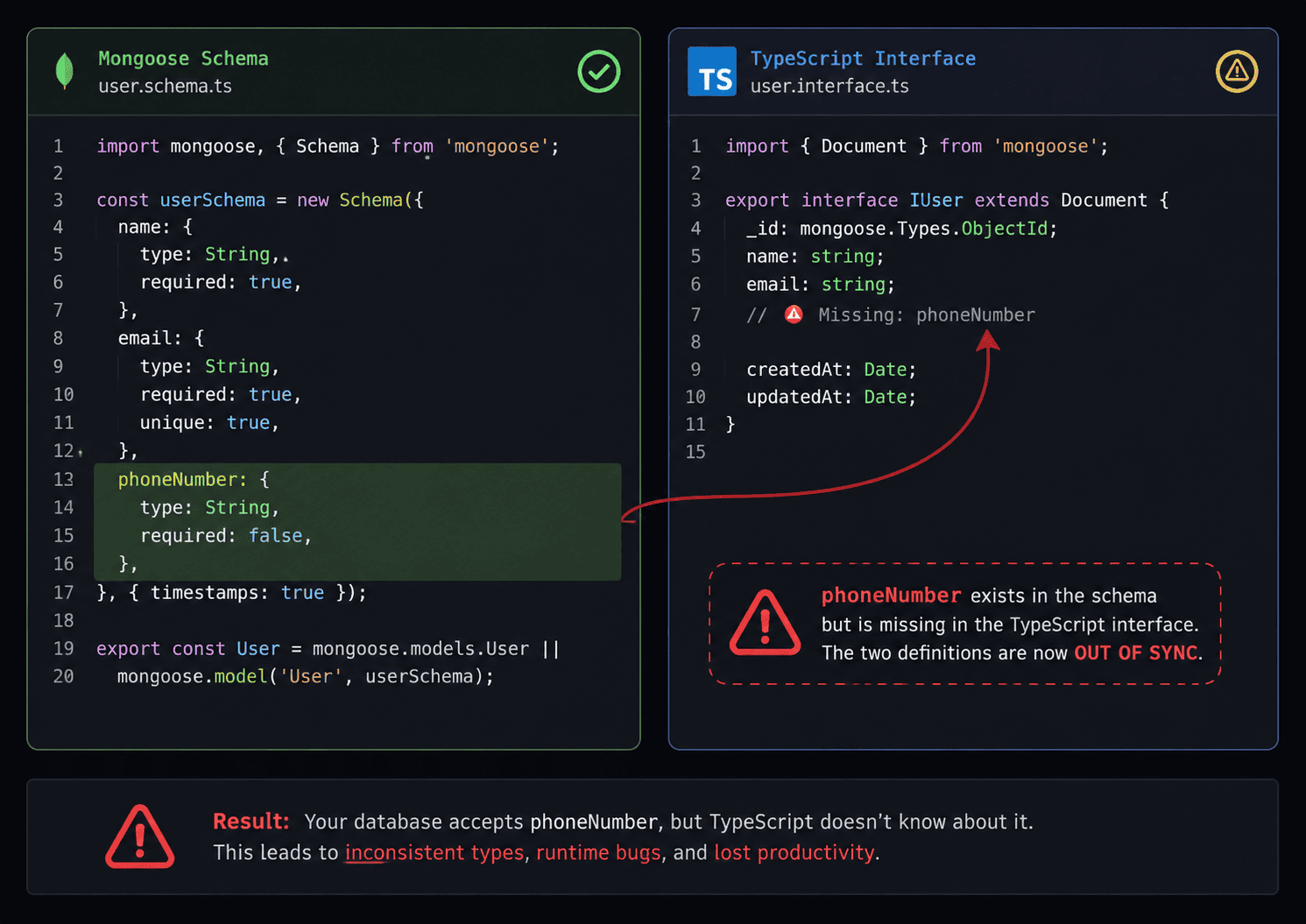
None of this is a Mongoose problem specifically, it's what happens any time a data shape is declared in two unrelated places. The fix isn't discipline or code review, it's removing the second declaration entirely and deriving it from the first.
InferSchemaType Fixes the Duplication, Not the Whole Problem
Mongoose ships a built-in utility type, InferSchemaType, that reads a schema definition and produces the matching TypeScript type automatically. It's been the officially recommended pattern for a while now, and it's the right default for new code:
import { Schema, InferSchemaType } from "mongoose";

const userSchema = new Schema({
  name: { type: String, required: true },
  email: { type: String, required: true },
  age: { type: Number, required: true },
});

type User = InferSchemaType<typeof userSchema>;
// { name: string; email: string; age: number }
The schema is now the single source of truth. Change a field's type in the schema and the derived User type updates on the next compile, automatically, with no second file to remember. This is the correct amount of effort for the duplication problem: delete one of the two places, keep the one that actually does something at runtime.
But User here is just the plain data shape, and that's a narrower thing than most people expect. It doesn't know about .save(), it doesn't know about ._id, and it doesn't know about anything Mongoose attaches to a document once it comes back from the database. If you try to call user.save() on something typed as plain User, TypeScript will correctly complain that save doesn't exist on that type, because as far as the inferred type is concerned, it's a description of the data, not a live document.
HydratedDocument Closes the Document Gap
This is the piece most quick tutorials skip entirely, which is exactly why it causes so much confusion downstream. HydratedDocument<T> wraps a plain inferred type with everything Mongoose adds at runtime once a document is created or comes back from a query: _id, save(), populate(), toObject(), and the rest of the Document interface.
import { HydratedDocument, model } from "mongoose";

type UserDocument = HydratedDocument<User>;

const UserModel = model<UserDocument>("User", userSchema);

const found = await UserModel.findOne({ email: "test@example.com" });
found?.save();       // typed correctly now
found?._id;           // typed correctly now
found?.toObject();    // typed correctly now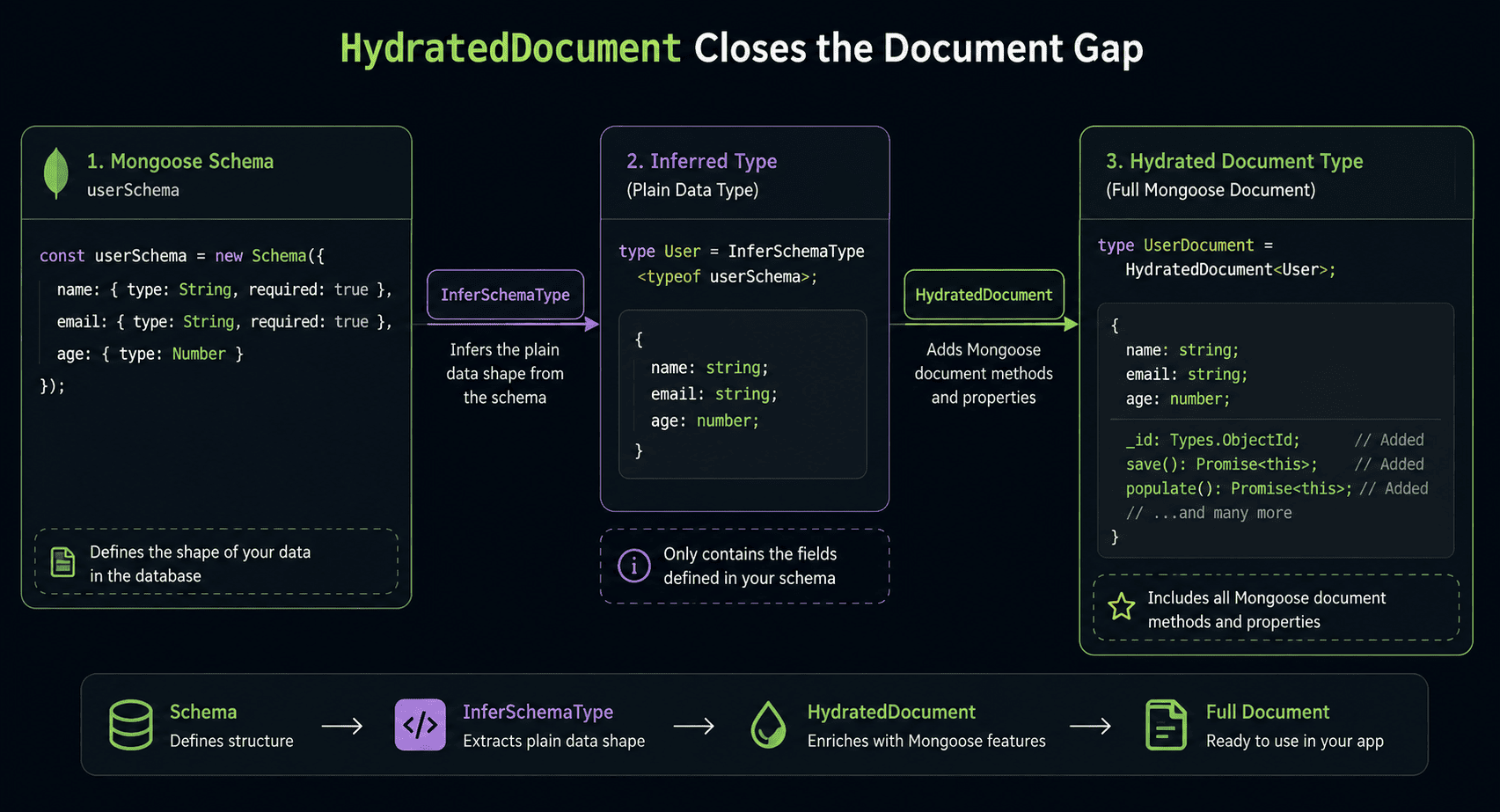
Skip this step and you'll spend an afternoon fighting TypeScript errors on totally ordinary Mongoose calls, save() doesn't exist, _id doesn't exist, and the instinct is usually to reach for as any on the query result rather than realize a two-line type wrapper was the actual fix. model<UserDocument>(...) is what makes every downstream query on UserModel come back already typed as UserDocument, so this only needs setting up once per model, not once per query.
Typing Instance Methods and Statics
InferSchemaType reads the field definitions, and only the field definitions. Custom instance methods and static methods attached to a schema live outside that object entirely, so they need to be typed explicitly and threaded through the schema's own generic parameters. This is the step that trips people up because the generics reference the schema's own inferred type, which looks circular the first time you write it, but it's the documented pattern and it does work:
import { Schema, model, HydratedDocument, InferSchemaType, Model } from "mongoose";

interface UserMethods {
  isAdult(): boolean;
}

const userSchema = new Schema<
  InferSchemaType<typeof userSchema>,
  Model<InferSchemaType<typeof userSchema>, {}, UserMethods>,
  UserMethods
>({
  name: { type: String, required: true },
  age: { type: Number, required: true },
});

userSchema.methods.isAdult = function () {
  return this.age >= 18;
};

type UserDocument = HydratedDocument<InferSchemaType<typeof userSchema>, UserMethods>;
const UserModel = model("User", userSchema);

const found = await UserModel.findOne();
found?.isAdult(); // fully typed, autocompletes correctly
Static methods, the ones called on the model itself rather than on a document instance, follow the same idea but attach through the schema's Model generic instead of the Methods one:
interface UserStatics {
  findByEmail(email: string): Promise<HydratedDocument<InferSchemaType<typeof userSchema>> | null>;
}

const userSchema = new Schema<
  InferSchemaType<typeof userSchema>,
  Model<InferSchemaType<typeof userSchema>, {}, {}, {}, unknown, UserStatics>
>({
  name: { type: String, required: true },
  email: { type: String, required: true },
});

userSchema.statics.findByEmail = function (email: string) {
  return this.findOne({ email });
};

const UserModel = model("User", userSchema);
const user = await UserModel.findByEmail("test@example.com"); // typedThe populate() Typing Trap
This is the one that causes the most genuine confusion, and there's an open issue on Mongoose's own GitHub repository where developers are stuck on exactly this, with no canonical fix linked from anywhere easy to find. By default, a referenced field types as its raw ObjectId, even after you've called .populate() on it at runtime:
const group = await Group.findById(id).populate("owner");
group.owner.name; // TypeScript error: owner is typed as ObjectId, not a document
The reason is structural, not a bug: .populate() is a database-level operation that changes the shape of the result at query time, and TypeScript's static type system has no way to see that a specific call to .populate("owner") changed owner from an ObjectId into a full User document. The type of group was already fixed at the point Group was defined. You have to tell TypeScript explicitly, using the generic parameter .populate() itself accepts for exactly this purpose:
const group = await Group.findById(id)
  .populate<{ owner: UserDocument }>("owner");
group.owner.name; // works, typed as UserDocument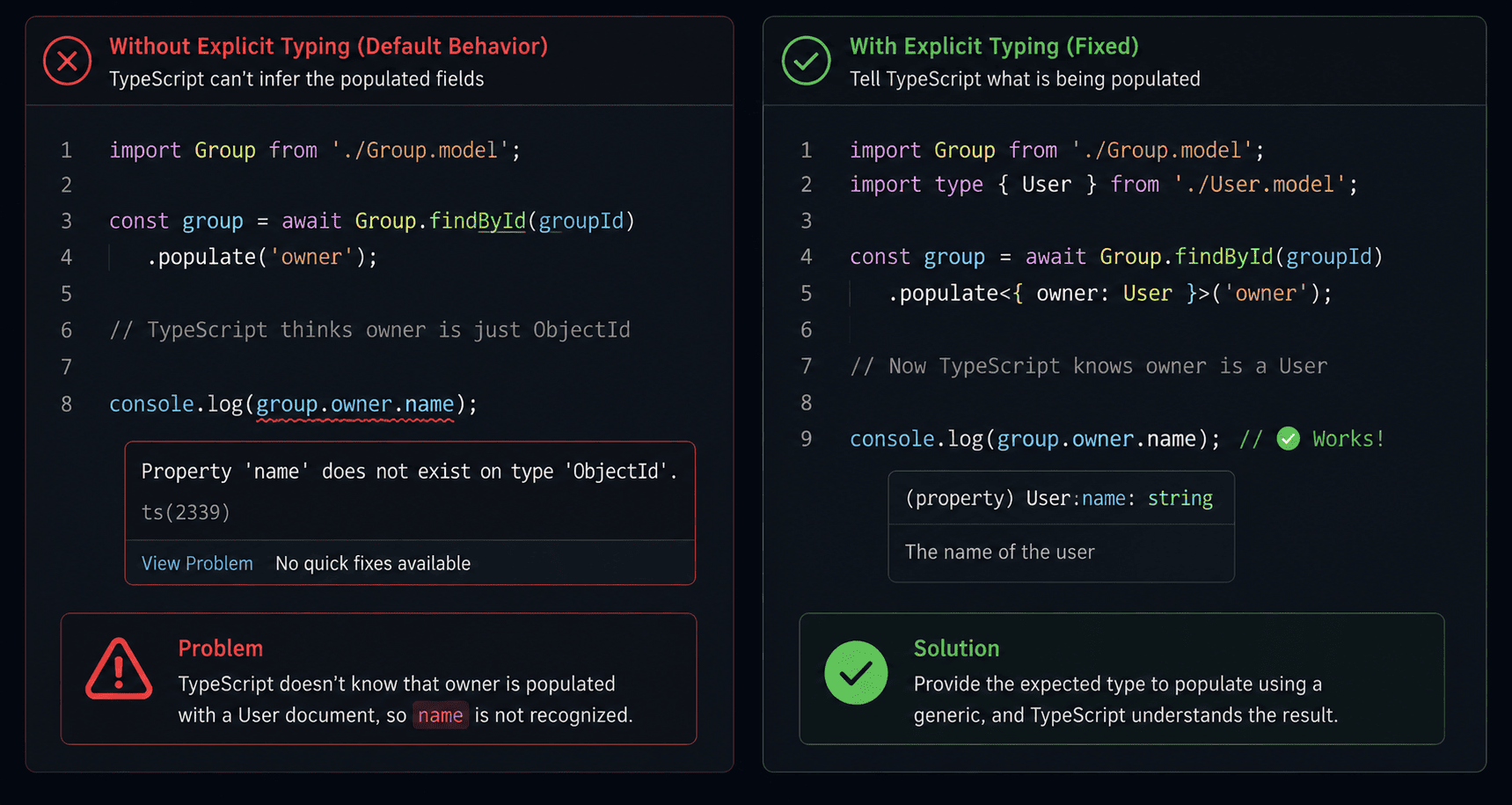
This scales the same way for populating multiple fields, or an array of references, chain multiple .populate() calls and pass each one its own generic, or intersect the shapes if you're populating in one call with an array of paths. If members is an array of refs, the populated shape is an array too:
const group = await Group.findById(id)
  .populate<{ owner: UserDocument; members: UserDocument[] }>(["owner", "members"]);

group.members.forEach((m) => m.name); // each member typed as UserDocument
Our MongooseTS tool detects any field with a ref option in a pasted schema and generates this exact populate snippet automatically, using your actual field and model names instead of a generic placeholder, so you don't have to reconstruct the syntax from memory every time.
Virtuals and Their Types
The same underlying issue applies to virtuals: they're computed at access time from a getter function, not stored in the database, so they're not part of the raw field definitions InferSchemaType reads either. If you want a virtual like fullName to show up as a typed property on your document, you need to add it to the type explicitly, the same way methods and statics get threaded through, this time via the schema's fourth generic parameter for virtuals:
interface UserVirtuals {
  fullName: string;
}

const userSchema = new Schema<
  InferSchemaType<typeof userSchema>,
  Model<InferSchemaType<typeof userSchema>, {}, {}, UserVirtuals>,
  {},
  UserVirtuals
>({
  firstName: { type: String, required: true },
  lastName: { type: String, required: true },
});

userSchema.virtual("fullName").get(function () {
  return `${this.firstName} ${this.lastName}`;
});

type UserDocument = HydratedDocument<InferSchemaType<typeof userSchema>, UserVirtuals>;
const UserModel = model("User", userSchema);

const found = await UserModel.findOne();
found?.fullName; // typed as string
It's worth calling out that virtuals aren't included in the result of .toObject() or .toJSON() unless you explicitly set { virtuals: true } in the schema's toObject/toJSON options, that's a runtime behavior detail, not a typing one, but it's the thing people usually hit right after finally getting the type correct: the type says fullName exists, and then it's missing from the JSON response because the schema option wasn't set.
When You Should Still Hand-Write an Interface
Inference is the right default, not a rule without exceptions. There are two situations where writing the interface first, and shaping the schema to match it, is still the better call.
The first is a genuinely conditional shape, most commonly a discriminator pattern where a field's type depends on the value of another field. InferSchemaType derives a single flat shape from a single schema definition, it doesn't reason about Mongoose discriminators producing different sub-shapes per kind:
// InferSchemaType can't express this on its own, a discriminator adds
// different fields per "kind" at the schema level, so the union has to
// be written by hand and the schema shaped to match it.
type Notification =
  | { kind: "email"; recipientEmail: string; subject: string }
  | { kind: "sms"; recipientPhone: string; body: string };
The second case is API-contract-first design: when the interface needs to exist before the schema does, because it's shared with a frontend, an OpenAPI spec, or another service, and the schema is being written to satisfy an already-agreed-upon shape rather than the other way around. In that situation, inferring from the schema would mean the contract lives implicitly inside a Mongoose-specific file, which is the wrong place for something other parts of the system depend on.
Outside of those two cases, treat inference as the default and reach for a hand-written interface only when you can point to a specific reason it's needed, not as a habit carried over from before InferSchemaType existed.
One Full Worked Example, Start to Finish
Putting all of the above together: a schema, a model, and an Express route that queries and populates a reference, fully typed from the schema definition down to the response.
import { Schema, model, HydratedDocument, InferSchemaType, Types } from "mongoose";

const groupSchema = new Schema({
  name: { type: String, required: true },
  owner: { type: Schema.Types.ObjectId, ref: "User", required: true },
  members: [{ type: Schema.Types.ObjectId, ref: "User" }],
  visibility: { type: String, enum: ["public", "private"], default: "private" },
  createdAt: { type: Date, default: Date.now },
});

export type Group = InferSchemaType<typeof groupSchema>;
export type GroupDocument = HydratedDocument<Group>;

export const GroupModel = model<GroupDocument>("Group", groupSchema);import { Schema, model, HydratedDocument, InferSchemaType } from "mongoose";
const userSchema = new Schema({
name: { type: String, required: true },
email: { type: String, required: true, unique: true },
});
export type User = InferSchemaType<typeof userSchema>;
export type UserDocument = HydratedDocument<User>;
export const UserModel = model<UserDocument>("User", userSchema);import { Router } from "express";
import { GroupModel } from "../models/group";
import type { UserDocument } from "../models/user";
const router = Router();
router.get("/groups/:id", async (req, res) => {
const group = await GroupModel.findById(req.params.id)
.populate<{ owner: UserDocument; members: UserDocument[] }>(["owner", "members"]);
if (!group) return res.status(404).json({ error: "Group not found" });
// Every field below is typed, including owner.name and each members[i].name,
// because the populate generic told TypeScript what the query actually returns.
res.json({
id: group._id,
name: group.name,
owner: { id: group.owner._id, name: group.owner.name },
members: group.members.map((m) => ({ id: m._id, name: m.name })),
visibility: group.visibility,
});
});
export default router;Nothing in this example is hand-maintained twice. The schema is the only place the shape is written down, InferSchemaType derives the data type from it, HydratedDocument adds the document behavior, and the .populate() generic covers the one spot TypeScript genuinely can't infer on its own.
Try It on Your Own Schema
Reading through generic examples only gets you so far, the interesting edge cases are always in your actual schema, not a toy one. If you want to see everything above applied to your own fields, paste your schema into MongooseTS and get the generated interface back instantly, either as a plain interface or the InferSchemaType style shown throughout this guide, with a ready-to-paste .populate() snippet for any ref field it finds. It runs entirely in your browser, nothing you paste is sent anywhere.
If your actual pain point right now is an aggregation pipeline rather than a model's shape, our PipelineExplain tool walks a MongoDB aggregation pipeline stage by stage in plain English, no database connection required, the other Mongoose-adjacent tool on the site.
Frequently Asked Questions
What does InferSchemaType actually do, in one sentence?
It's a TypeScript utility type, built into Mongoose, that reads a schema's field definitions and produces the matching plain data type automatically, so you don't hand-write a second interface that has to be kept in sync with the schema by hand.
It only operates at the type level: string, number, boolean, ObjectId, arrays, and nested subdocuments all map to their TypeScript equivalents, but it has nothing to do with runtime validation. Options like required or unique are still enforced by Mongoose against the database exactly as before, InferSchemaType doesn't change that behavior or duplicate it. Because it's purely a compile-time construct, it also costs nothing at runtime, there's no extra bundle size, no extra function call, and no performance tradeoff versus a hand-written interface, the type simply disappears once TypeScript finishes checking your code.
Do I always need HydratedDocument, or only sometimes?
You need it anywhere you're working with a real document returned from a query, created with new Model(...), or passed into .save(). You don't need it for a plain data shape that's never going to call a document method, for example a DTO you're sending back from an API response that only has plain fields on it.
In practice, almost every model benefits from exporting both: the plain InferSchemaType type for shape-only contexts, and the HydratedDocument-wrapped type for anything that touches the database directly, exactly as shown in the worked example above.
What Mongoose version do I need for InferSchemaType and HydratedDocument?
Both have been stable, documented parts of Mongoose for several major versions now, so any reasonably current install has them. If you're specifically on Mongoose 9 or upgrading to it, check our Mongoose 9 migration guide first, the stricter query-filter type checking introduced there can surface new tsc errors on code that compiled cleanly before, independently of anything covered in this guide.
One thing worth checking directly in your package.json: make sure the separate @types/mongoose package isn't installed alongside Mongoose itself. Mongoose has bundled its own TypeScript definitions for a long time now, and having both installed at once is a common source of conflicting-type errors, duplicate identifier complaints, or types that look subtly wrong in ways that have nothing to do with your schema. Removing @types/mongoose entirely and relying on the types Mongoose ships is the current recommended setup.
How does InferSchemaType compare to typegoose?
| typegoose | InferSchemaType | |
|---|---|---|
| Schema syntax | Decorator-based, rewrites how you define schemas | Plain Mongoose schema syntax, unchanged |
| Migration cost on an existing codebase | High, every schema is rewritten | Low, add a type alias next to each existing schema |
| Source of truth | The decorated class | The schema object itself |
| Best fit | New projects standardizing on class-based models | Existing Mongoose codebases adding types incrementally |
typegoose solves the same duplication problem from a different angle: your class definition becomes the single source of truth, and typegoose generates the Mongoose schema from it, the reverse direction of InferSchemaType. It's a solid choice for a project standardizing on it from day one, but it means abandoning plain Mongoose schema syntax project-wide, which is a much bigger ask than adding a type alias next to schemas you already have.
How do I generate types for every schema in my project at once, not just one?
InferSchemaType already does this for you incrementally: add type X = InferSchemaType<typeof xSchema> next to each schema as you touch it, there's no separate generation step or build tool needed, it's a plain TypeScript type computed at compile time.
If you specifically want a CLI that walks your whole models/ directory and emits .d.ts files as part of a build step, that's a different tool category entirely, mongoose-tsgen is the actively maintained option there. Our MongooseTS tool is for the opposite moment, checking a single schema instantly, before deciding whether a project-wide CLI setup is worth it.
I added the populate() generic and it's still not typing correctly, what's wrong?
The most common cause is a mismatch between the field name passed to .populate() as a string and the key used in the generic object, they have to match exactly, including nested paths. The second most common cause is populating a field that isn't actually a ref in the schema, in which case there's nothing for TypeScript to reconcile, the generic is telling the type system to trust you about a transformation that isn't happening at the database level.
// Mismatch: generic key "owner" but populate call uses "ownerId"
await Group.findById(id).populate<{ owner: UserDocument }>("ownerId"); // wrong

// Matching
await Group.findById(id).populate<{ owner: UserDocument }>("owner"); // correctRelated Articles
Mongoose 9 Migration Guide: What Actually Breaks in a Real MERN App
Upgrading to Mongoose 9? Here's what actually breaks in real MERN apps: pre-save hooks, plugins, TypeScript types, and how to fix each one.
30 Node.js Interview Questions and Answers (2026)
30 Node.js interview questions with full answers: event loop, streams, clustering, worker threads, memory leaks, and security. Updated for 2026.
TypeScript 7 Migration Guide: tsgo, Breaking Changes, Build Times
Migrate to TypeScript 7 (tsgo): install the beta, fix the 4 breaking changes, update tsconfig, and decide if upgrading now is worth it.